
This is a beginning research program focused on helping parents with technoference.

Parental technoference occurs when parents are focused on their phones or other technology, which affects time spent with their child.
We reviewed 64 studies on parental technoference and found that parental technoference affected parent-child interactions and parent-child relationships, children’s behaviors, adolescents’ mental health, child safety, child development, and children’s technology use (Komanchuk et al., 2022).
Our published paper (Komanchuk et al., 2022) revealed the following key findings:

When parents were immersed in their phone, they often missed their child’s cues1,3,6. Children also reacted to parental technoference. For example, some young children acted out (e.g., hitting) and others withdrew1.
Parental technoference was linked with children’s behavioral problems4, poorer mental health in adolescence, such as depressive symptoms7,9 and problematic technology use, such as cyberbullying5,8.
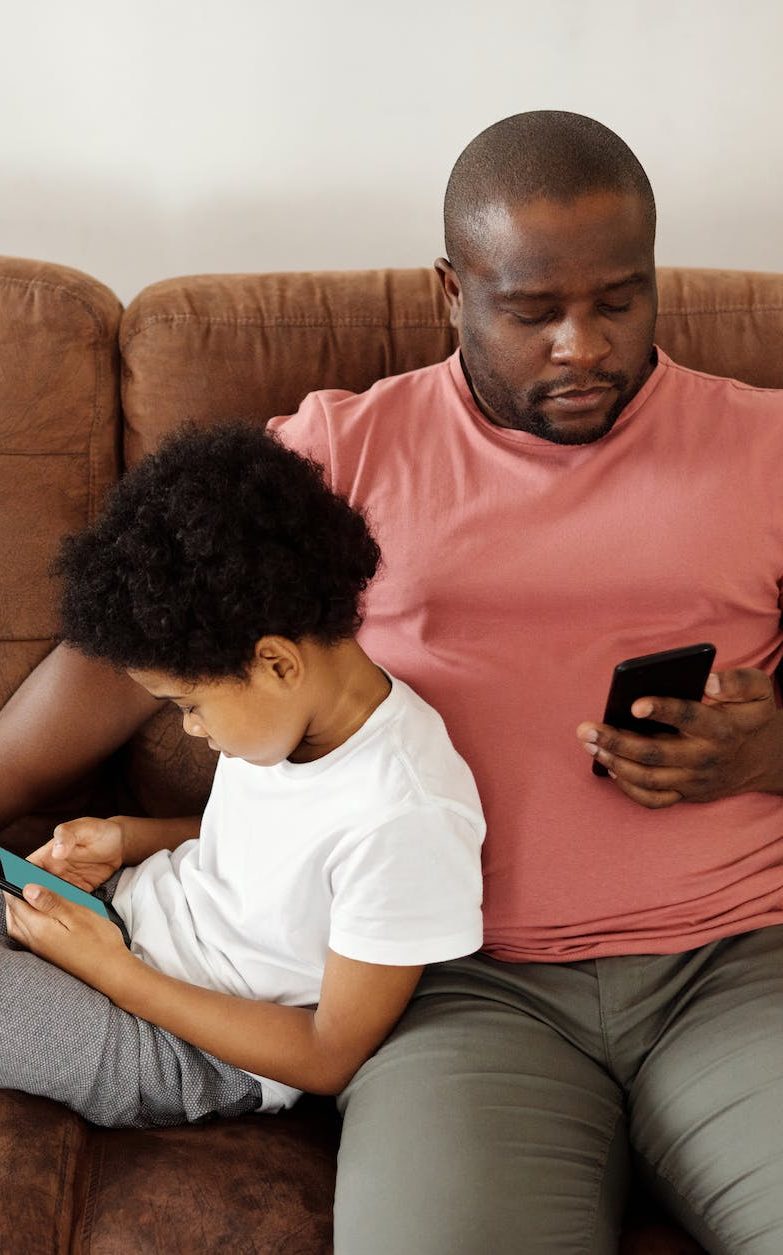

Parent-child interactions are important!
High quality parent-child interactions are seen when parents pay attention to their child’s cues and respond quickly and appropriately. For example, a parent sees that their baby is frowning and trying to move away from a noisy toy. The parent thinks that their baby is likely overwhelmed by the toy, so they turn off the toy and soothe their baby. The baby settles. The parent is showing sensitivity and responsivity to their child.
The Harvard Center on the Developing Child refers to high quality parent-child interactions as “serve and return” interactions. In these interactions, children serve their parents (like a game of tennis) by showing their parents cues (e.g., smile, laugh, frown, pointing at something that interests them), and the parent returns the child’s serve by recognizing and responding to their child’s cues (see https://developingchild.harvard.edu/science/key-concepts/serve-and-return/)
This body of research is still new and, to our knowledge, no programs to date have been tested to help parents balance using technology while remaining attentive and responsive to their child.
References
- Elias, N., Lemish, D., Dalyot, S., & Floegel, D. (2020). “Where are you?” An observational exploration of parental technoference in public places in the US and Israel. Journal of Children and Media, 15(3), 376-388. https://doi.org/10.1080/17482798.2020.1815228
- Komanchuk, J., Toews, A. J., Marshall, S., Mackay, L. J., Hayden, K. A., Cameron, J. L., Duffet-Leger, L., Letourneau, N. (2022). Impacts of parental technoference on parent-child relationships and child health and development: A scoping review. [Manuscript Submitted to Cyberpsychology, Behavior, and Social Networking]
- Lemish, D., Elias, N., & Floegel, D. (2020). “Look at me!” Parental use of mobile phones at the playground. Mobile Media & Communication, 8(2), 170-187. https://doi.org/10.1177/2050157919846916
- McDaniel, B. T., & Radesky, J. S. (2018). Technoference: Longitudinal associations between parent technology use, parenting stress, and child behavior problems. Pediatric Research, 84(2), 210-218. https://doi.org/10.1038/s41390-018-0052-6
- Qu, J., Lei, L., Wang, X., Xie, X., & Wang, P. (2020). Mother phubbing and adolescent cyberbullying: The mediating role of perceived mother acceptance and the moderating role of emotional stability. Journal of Interpersonal Violence, NP9591-NP9612. https://doi.org/10.1177/0886260520983905
- Radesky, J. S., Kistin, C. J., Zuckerman, B., Nitzberg, K., Gross, J., Kaplan-Sanoff, M., Augustyn, M., & Silverstein, M. (2014). Patterns of mobile device use by caregivers and children during meals in fast food restaurants. Pediatrics, 133. https://doi.org/10.1542/peds.2013-3703
- Wang, X., Gao, L., Yang, J., Zhao, F., & Wang, P. (2020). Parental phubbing and adolescents’ depressive symptoms: Self-esteem and perceived social support as moderators. Journal of Youth and Adolescence, 49(2), 427-437. https://doi.org/10.1007/s10964-019-01185-x
- Wang, X., Wang, W., Qiao, Y., Gao, L., Yang, J., & Wang, P. (2020). Parental phubbing and adolescents’ cyberbullying perpetration: A moderated mediation model of moral disengagement and online disinhibition. Journal of Interpersonal Violence, 116, 1-23. https://doi.org/10.1177/0886260520961877
- Xie, X., & Xie, J. (2020). Parental phubbing accelerates depression in late childhood and adolescence: A two-path model. Journal of Adolescence, 78, 43-52. https://doi.org/https://doi.org/10.1016/j.adolescence.2019.12.004
 TIPP Program