
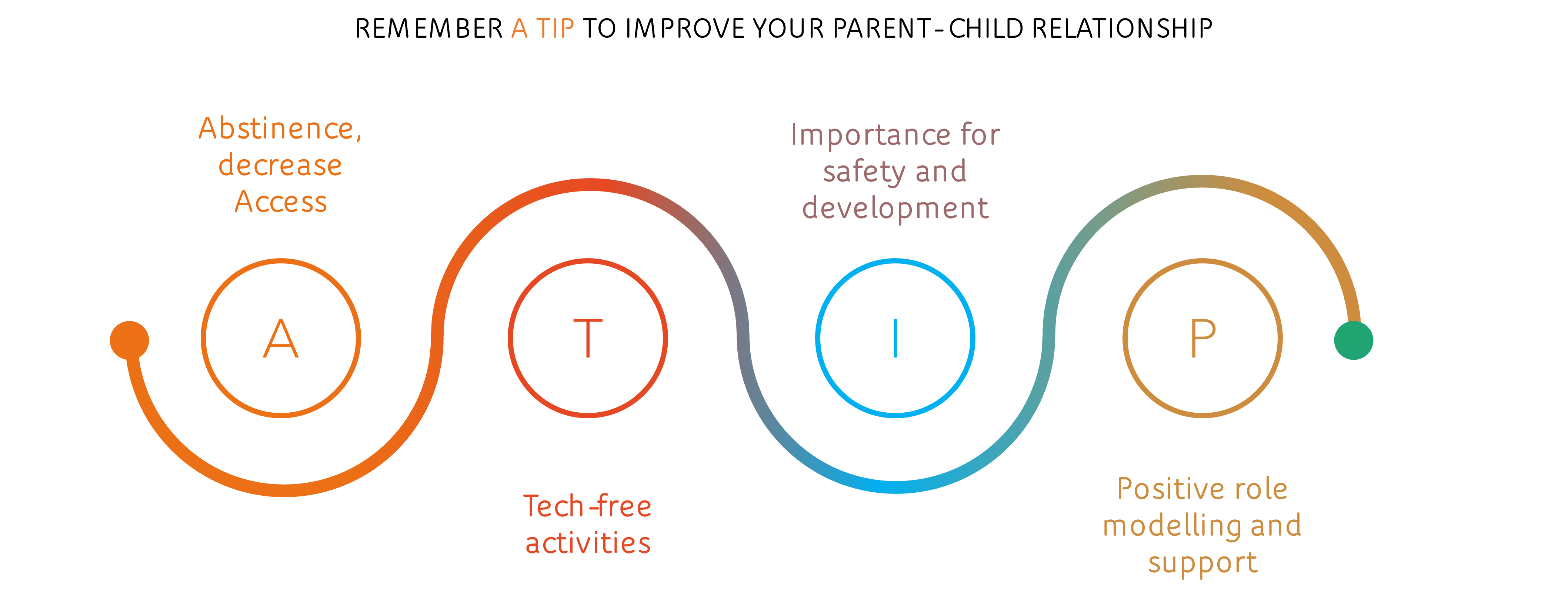
Abstinence,
decrease Access

Create Daily Tech-Free Time
Every day, put your screen away and try to spend 20 minutes of uninterrupted time with your child. Turn off the TV, close the laptop, leave your phone in another room and allow your child to consume your next 20 minutes.
Do something your child enjoys (without screens) and be completely present to them. This consistent and reliable one-on-one time is one of the best things you can do for your child. It fills their need for attention before they start begging for it or misbehaving – which is often a foolproof way of getting your attention. This tech-free, one-on-one time makes them feel valued. And it helps build the strong relationship you both desire.1, 2

Set Boundaries
Choose times of the day when you will check your phone and limit that time around your children. Set physical boundaries in your home, by making certain areas tech-free. For instance, a good rule is no devices during family activities such as dinnertime, playtime, and bedtime.1, 3, 11
The strategy of short-burst phone use could be practiced: taking out the phone, looking at the screen momentarily, putting it away, and then returning to attending to their children.8
The strategies of leaving the device in a bag, at home, or in the car, and choosing a phone function mode such as a silent or camera.4
Track Your Screen Time
Notice how often you check your devices and the times of day when you do can help you to minimize screen time in the future.1
Establish healthy screen time habits early on.14
Stick to a number of minutes or hours per day to screen time through TV sleep timers or setting time controls on devices or third-party app on tablets and smartphones. 14

Tech-free Activities
Play games that do not require any special equipment – peekaboo, pat-a-cake, and Itsy Bitsy Spider and activities like blowing kisses, waving goodbye, and clapping for building social skills.
Creative arts – listening to music, making music, singing, drawing, and trips to the local museum or art gallery.
Read to your children, and encourage them to “read” to you, even if they are not truly reading the words on the page. This encourages language development and an early love of reading. Visits to the local library can be fun experiences as well, and many libraries offer weekly storytime activities for infants and young children.
Simple, inexpensive toys – dolls, jump ropes, blocks, puzzles, balls, and buckets are more effective at engaging children in creative play and critical thinking than expensive toys, which can make play more passive and less physical. Outdoors – dirt, trees, grass, rocks, flowers, and insects
Physical play – tummy time, crawling, rolling, running, jumping, hide-and-seek, and ball games. 3, 11

Importance for safety and development


It’s important to be aware that close caregiver supervision can be compromised by technology. For example, when parents were on their mobile device for a full minute, the potential for injury increased at the playground, compared to parents not using their mobile devices.4
Parental use of cell phones does not provide any benefits to an infant’s development, while it may negatively affect the development of joint attention.6
When parents are on their devices during family activities, they tend to be more hostile when their children vie for their attention. This not only leads to limited bonding experiences, but an increase in number of negative interactions between parents using screens and children wanting their attention.10,13
The media usage of parents can impact the child’s language development. Parents should consider the implications their screen time has on their children’s emotional needs, behavior, language development and safety.14
Background television limits conversations and fewer interactions between parents and children, and this can in turn impair children’s language skills.5, 9, 12, 14
Positive role modelling and support

Shifting off screens
BE PREPARED – Make a plan for redirection or reset ahead of time.
Warning Transition Ahead
Transitions are always easier when we know they are coming and what to expect on the other side. Give kids incremental warnings in advance of the transition, and make sure they know what they’re transitioning to, not just that they have to turn off the screen.
Bring it into Perspective
Young kids’ sense of time and future aren’t yet fully developed, and so it may feel like this is their only opportunity for screen time, especially if screen time isn’t part of a regular routine. It may be helpful to remind kids of the next time they will have the chance to play their game or watch their show.
Speak their Language
Young children may not yet understand units of time in any meaningful way. Therefore, it can be really helpful to use units of time that make sense to kids as you help them prepare for the transition. Say things like “Once Elmo says goodbye, we are going to turn the TV off” or “one more song and then the tablet goes night-night.” Visual indicators of time such as digital timers and hourglasses are great tools for transitions, too!
For example, you might say “You have 10 minutes left with your tablet, then it’s time to get ready for the park.”

Entertain as you Go
Doing something fun as you transition from screen time to another activity can make all the difference! Whether it’s a game of “I Spy” or “Follow the Leader”, or even just singing a favorite song or reading a preferred book, transition moments can be some of the most fun on any day!
Stick to It!
Be consistent and stick to your word makes for a much smoother transition- if not this time, then definitely next time! Kids thrive on consistency and structure, and routines can help establish expectations for transitions that make them easier for everyone involved.
I Wanna be Like You
Be consistent and stick to your word makes for a much smoother transition- if not this time, then definitely next time! Kids thrive on consistency and structure, and routines can help establish expectations for transitions that make them easier for everyone involved.
From Fun to Funner
Screen time is highly stimulating and is often something kids look forward to. If you ask children to turn off their screens and then immediately do something they don’t love doing, like cleaning up or taking a bath, you’re making the transition harder on yourself. Instead, choose a preferred activity as a buffer!
Out of Sight, Out of Mind
If possible, it can be helpful to transition to a screen-free location after screen time. This is especially true if someone else is using screens in the room (like an older sibling), which might make it more frustrating and difficult for your little one to understand why they can’t.
Reinforce, Reinforce, Reinforce

Offer praise and other forms of positive reinforcement when a transition goes smoothly to encourage the same behavior in the future! Reinforcing your child each and every time will help get good habits started, but in order to develop stronger internal motivation, over time you might try offering intermittent rewards of varying degrees.
Parent-child communication on mobile phone use can help children to form positive perceptions of mobile phones, reduce their desire to problematic mobile phone use, and increase their self-control towards mobile phone use.4
Parental phubbing (being snubbed by someone on a mobile phone) negatively affects adolescents’ attitudes and behaviours toward problematic phone use, and can actually increase the problematic behaviour”. “This suggests that parents’ behaviours play a substantial role in their youths’ mobile phone use.7
Parental active mediation, which refers to parental involvement and supervision of media use by restriction, co-viewing, and/or communication about the media use, can promote youths’ understanding of their parents’ attitudes toward mobile phone use. This allows youths to integrate their parents’ perspectives toward self-control of mobile phone use into their own thoughts. And this can decrease youths’ mobile phone dependency.7
References
- (n.d.). How is Technoference Affecting Your Relationship with Your Child? Peace at Home Blog. Retrieved May 30, 2023, from https://peaceathomeparenting.com/technoference-technology-and-parenting
- (n.d.). Shifting Off Screens. Children and Screens. Retrieved May 30, 2023, from https://www.childrenandscreens.com/media/press-releases/shifting-off-screens/
- American Academy of Pediatrics. (2016). Parents of young children: Put down your smartphones. Retrieved from https://www.healthychildren.org/English/ family-life/Media/Pages/Parents-of-Young-Children-Put-Down-Your-Smartphones.aspx
- Bury, Keira, et al. “Parent Mobile Phone Use in Playgrounds: A Paradox of Convenience.” Children (Basel), vol. 7, no. 12, 2020, p. 284–, https://doi.org/10.3390/children7120284.
- Christakis, D. A., Gilkerson, J., Richards, J. A., Zimmerman, F. J., Garrison, M. M., Xu, D., Yapanel, S. (2009). Audible television and decreased adult words, infant vocalizations, and conversational turns: A population based study. Archives of Pediatrics & Adolescent Medicine, 163, 554–558. doi:10.1001/archpediatrics.2009.61
- Davidovitch M, Shrem M, Golovaty N, Assaf N, Koren G. The role of cellular phone usage by parents in the increase in ASD occurrence: A hypothetical framework. Medical Hypotheses. 2018;117:33-6.
- Fu, Xinchen, et al. “The Impact of Parental Active Mediation on Adolescent Mobile Phone Dependency: A Moderated Mediation Model.” Computers in Human Behavior, vol. 107, 2020, p. 106280–, https://doi.org/10.1016/j.chb.2020.106280.
- Hiniker, Alexis, et al. “Texting While Parenting: How Adults Use Mobile Phones While Caring for Children at the Playground.” Proceedings of the 33rd Annual ACM Conference on Human Factors in Computing Systems, ACM, 2015, pp. 727–36, https://doi.org/10.1145/2702123.2702199.
- Kirkorian, H. L., Pempek, T. A., Murphy, L. A., Schmidt, M. E., & Anderson, D. R. (2009). The impact of background television on parent–child interaction. Child Development, 80, 1350–1359. doi:10.1111/j.1467-8624.2009.01337.x
- McDaniel, B. T., & Radesky, J. (2017). Technoference: Parent distraction by technology and associations with child behavior problems. Child Development, 89(1). doi:10.1111/cdev.12822
- Milteer, R. M., & Binsburg, K. R. (2012). The importance of play in promoting healthy child development and maintaining strong parent-child bond: Focus on children in poverty. Pediatrics, 129(1). doi:10.1542/peds.2011-2953
- Pempek, T. A., Kirkorian, H. L., & Anderson, D. R. (2014). The effects of background television on the quantity and quality of child-directed speech by parents. Journal of Children and Media, 8, 211–222. doi:10.1080/17482798.2014.920715
- Radesky, J. S., Kistin, C. J., Zuckerman, B., Nitzberg, K., Gross, J., KaplanSanoff, M., & Silverstein, M. (2014). Patterns of mobile device use by caregivers and children during meals in fast food restaurants. Pediatrics, 133(4), 843-849. doi:10.1542/peds.2013-3703.
- JC. Limiting technoference: Healthy screen time habits for new parents. International Journal of Childbirth Education 2019;34:54-9.
 TIPP Program